TO OFFER YOU A BETTER EXPERIENCE, THIS SITE USES COOKIES, INCLUDING THOSE OF THIRD PARTIES. TO FIND OUT MORE, CONSULT THE PRIVACY POLICY


Breast cancer is the most common cancer in the Philippines with 3 out of 100 women expected to be diagnosed in their lifetime.
Conversations about preventing, treating, and living with cancer are not easy but these are important stages of the cancer journey for both the patient, their families, and friends.
With October being breast cancer awareness month, we share some information about how to respond to and support a loved one if they are diagnosed with cancer. It is important to remember that there is no manual on how to react to the news.
The initial shock
Cancer diagnosis usually comes as a shock. Sometimes the mind jumps to questions like: Am I going to die? Is the diagnosis correct? What do I do? Will I lose my breast? Will I lose my hair? How will my life change?
What would usually follow are emotional processing, gathering of professional opinions and information on next steps and available treatments, confirming if the diagnosis is correct, understanding the disease, and the risks and effects of treatments.
What friends and family should keep in mind
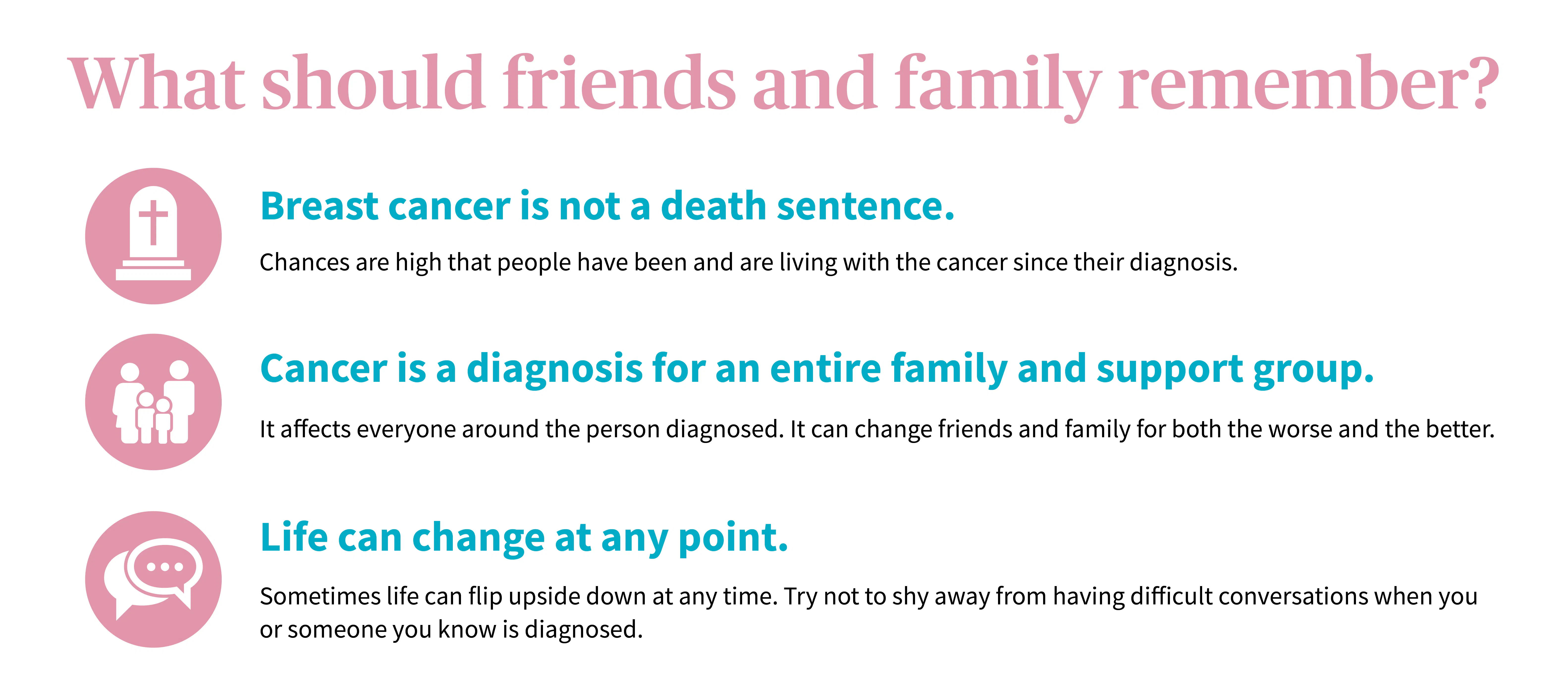
· Breast cancer is not a death sentence. Although we associate cancer with death, chances are high that people have been and are living with the cancer since their diagnosis. A breast cancer diagnosis and undergoing treatment is only one part of living.
· Cancer is a diagnosis for an entire family and support group. It affects everyone around the person diagnosed. It can change relationships between friends and family for both the worse and the better.
· Life can change at any point. We have that misconception and misinformation as a society that it will not happen to me or to someone close to me. Don’t shy away from having difficult conversations when yourself or someone you know is diagnosed.
How we react could fall everywhere on a wide spectrum. There are those who are not ready to deal with the news and might just disappear. Then, there are also those who would commit unconditionally and are there for patients every step of the way.
Most people fall somewhere in the middle — wanting to be there because they sincerely care, but not knowing how. They alternate between not seeming to care and not wanting to overstep.
The do’s and don’ts
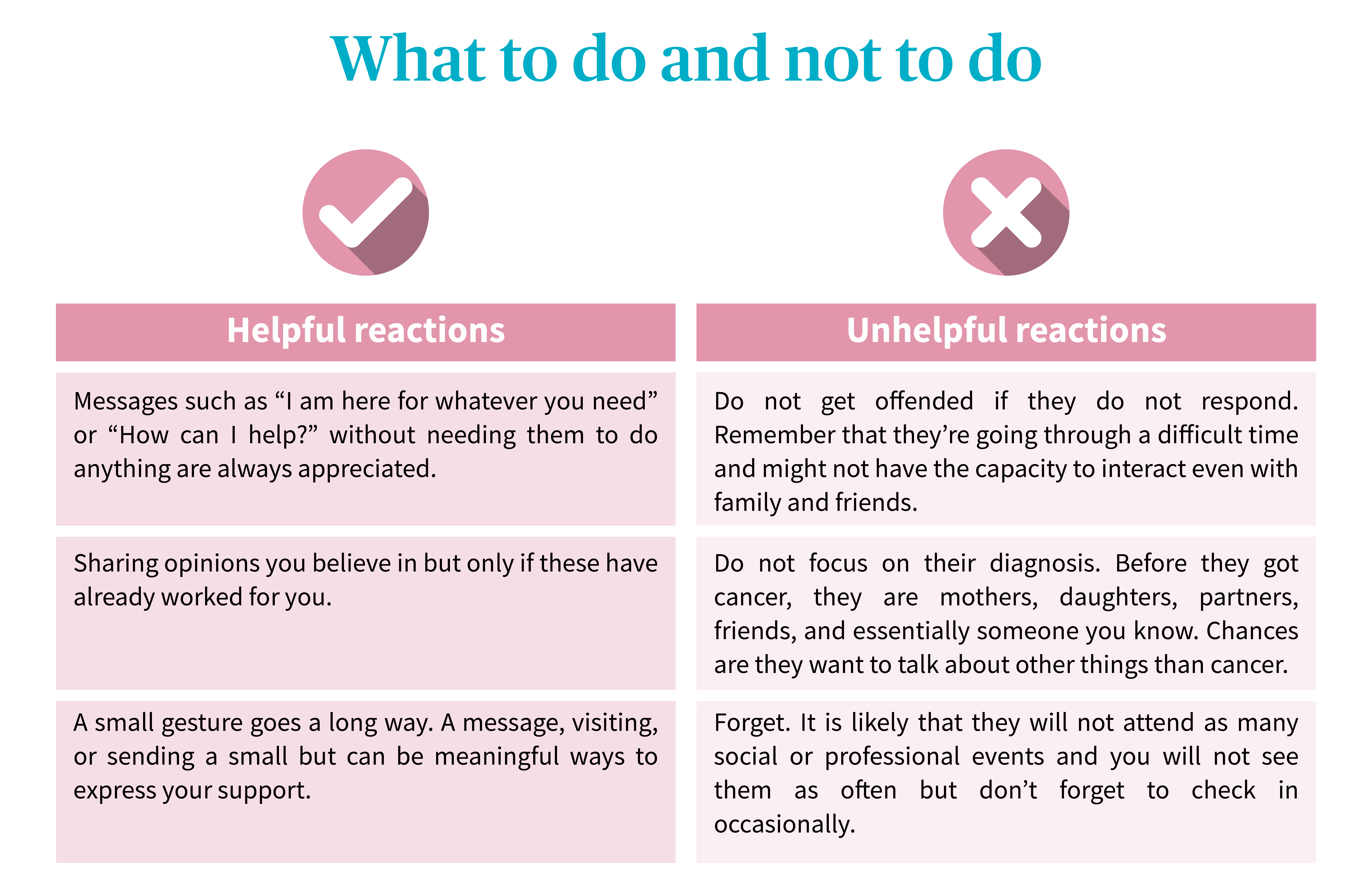
If someone you know has been diagnosed with breast cancer and shared the news with you, don’t be afraid to show your support and ask what they need.
Sharing love, listening, and simply showing up can be a big part of their healing and support as they undergo the experience of diagnosis, treatment, and post-treatment. How we react matters so we must also be conscious of this.
Remaining positive
Love and friendship. While going through challenging periods in life, we get to see those who are really there for us and realise the strength of their love.
Gratitude. When confronted with illness, it helps us to stop taking things for granted. There is much to learn about being grateful.
Acceptance. It is also easy to reject negative emotions and this is the opposite of acceptance. Acknowledge the negative without criticizing, judging, or trying to will yourself into being different because that is what you think you should do. Trying to take “should” out of the vocabulary helps.
New people and perspectives. In dealing with cancer, most would undergo many new experiences and encounter new people and perspectives. For instance, there is a lot to learn from other treatment and healing methods practiced in other cultures.
Empathy and forgiveness. Many of us experience difficult times, whether it is a disease, a loss, pain, or insecurity. We have no way of knowing what someone else is experiencing but what we can certainly do is to be more empathetic and forgiving as well as be willing to listen.
The increasing number of breast cancer survivors and vast improvements in science and research give hope that one day we will have a cure. In the meantime, we get to learn and appreciate life in all its complexity and beauty. As we acknowledge those living with cancer, we can better understand the disease and support each other through and after.
Cancer and other critical illnesses can be diagnosed when we least expect them and may persist. In such cases, AXA’s wide range of health solutions covering critical illnesses can help you be more prepared. Check these out by visiting AXA’s Health Hub: AXA Philippines | AXA Health Page[NS1]
Preferred Global Health (PGH) is a valued partner of AXA’s Preferred Consultation and Care (PCC) service. The partnership between AXA Philippines and PGH gives eligible AXA policyholders access to PCC where they can get expert advice for diagnosis verification and treatment plans from highly experienced Harvard-affiliated doctors. It provides patients the opportunity to make informed decisions in case of diagnosis of cancer and heart disease.
PGH is a leading global patient organization based in Boston, Massachusetts, USA with more than 20 years of experience in patient advocacy and supporting patients and their families on the path to recovery.


Loading Content...